Crying of Lot 49


Thomas Pynchon isn't an easy read, but he's funny and inventive. Part Joyce in his obscurity, part Kafka in the disorientation you feel. I read the Pinchon wiki to pick up on obscure references, before, during and after reading a chapter. 

Quote: "... he began to narrate for their entertainment a surfer orgy he had been to a week before, involving a five gallon can of kidney suet, a small automobile with a sun roof, and a trained seal."

I really liked the book. The complex sentences, the obscure references, the absurd names and characters.


Links:

Pynchon Wiki with its lovely notes. 

" In essence, the reason Pynchon rejects interviews regarding the subtext of his literature is based on Driblette's monologue as he, like Pynchon, describes the writing is in his head, yet the paradox is that his esoteric phrases leaves one to go in depth to understand what he is saying." Chapter 3 notes

"As ever with Pynchon's writing, the labyrinthine plots offer myriad linked cultural references." (Wikipedia)

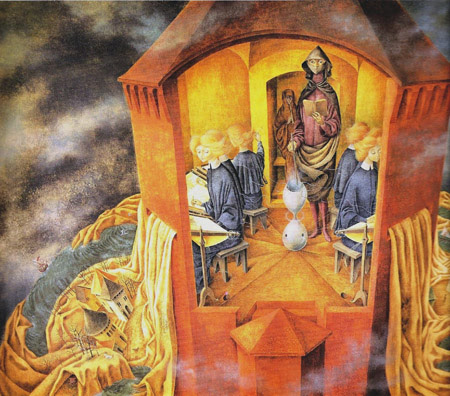
Remedios Varo She painted the painting above called Bornando el Manto Terrestre

NY Times review in 1966. The book was published in 1955.

Wikipedia novel entry.

The novel is included in the Times 100 Best Novels

r/ThomasPynchon's discussion of novel, chapter by chapter

Pynchon In Public Podcast: chapter 1 of CoL49

Comments

Popular posts from this blog

Manet and Degas

  Brilliant video explaining the exhibit. Go to the Met and see the exhibit! It's really quite special.  In the last gallery the painting this sketch is based off of, of the execution of a Mexican president. The painting has been cut into sections, and the surviving Degas has reassembled them. NY Times review

The case for Harris

Motley Kamuka Blog endorses Kamala Harris. In general, Trump just wants to lower taxes on the rich, and do nothing, sell whatever influence he can to line his pockets. Apparently the emoluments clause in the constitution has no teeth. Harris has a set of ideas about policy that are fairly middle of the road. In most countries she's would be seen as a centrist. Spin about her radical agendas are exaggerated.  I'm not sure how he got past " grab them by the pussy ", but he did and here we are. Women: Obviously the idea of giving women pregnancy tests at the borders of the state, and then if they come back and don't have a baby, they go to jail, isn't really what most women want. Pick Harris.  I understand if you think abortion is murder, maybe you've been told that by the Catholic church, which has the same ideal of Buddhism that you don't kill--so follow your religion for yourself. Not everyone is Christian or Buddhist or even has a religion. Women are ...

Gravity's Rainbow Notes Franz Pokler

From pp 397-433: Franz Pokler , a German rocket scientist. He is marginally associated with early attempts to develop rockets in the 1920's. During the war, Weissmann controls Pokler, giving him routine assignments and keeping him in line by allowing him yearly visits from a girl who he says is Pokler's daughter. The girl spends the rest of the year in a concentration camp, and Weissmann's implied threat is that she will be killed if Pokler fails to cooperate with Weissmann's scheme. Weissmann's purpose is to use Pokler to make one small part for the A4 rocket. In the end, having performed his task, Pokler is released; Slothrop meets him living quietly in the ruins of a children's village after the end of the war. His daughter also survives. Wiki notes on the Franz Pokler section 397-433 Abstract of "Franz Pökler's Anti-Story: Narrative and Self in Gravity's Rainbow" by Robert L. McLaughlin. (access the article  here  from  Pynchon Notes ) Gra...